Ask which source is inside it.
CO2 machines are sold on maximum wattage and a list of modes. Neither tells you what energy actually reaches the skin. This site explains the technology in plain language and gives you the questions that separate a laser platform from a cabinet with a screen on it.
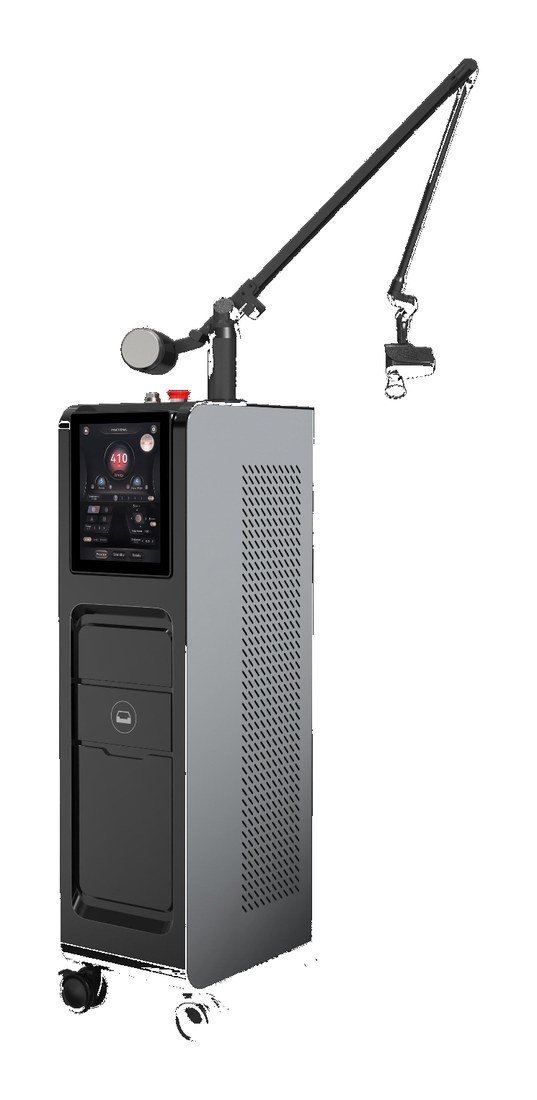
Three things this site will not do
- Promise a result. No downtime figures, no session counts, no before-and-after galleries. Outcomes depend on indication, skin type, protocol and the practitioner.
- Say “FDA approved”. A Class II CO2 laser is cleared under a 510(k) number. Anyone selling you the word “approved” has not read their own paperwork.
- Claim every machine does everything. Intended use, attachments and permitted procedures differ by model and by practitioner qualification.
Every question, one clear page.
Start with the technology, then the components that decide delivered energy, then the buying decision.
What Is a CO2 Fractional Laser?
Ablative, fractional, 10,600 nm — what each of those words actually means for the machine you are buying.
Read guide →02How Does a CO2 Fractional Laser Work?
From gas tube to tissue in nine steps — and the two numbers buyers wrongly compare machines on.
Read guide →03The Laser Source and What Power Really Means
The tube decides everything downstream — and a real spec sheet names it.
Read guide →04Scanner, Arm and Spot Quality
The optical path between source and skin — seven joints, a lens and a motor, any of which can ruin the pattern.
Read guide →05Surgical vs Fractional Mode
Same source, different delivery — and very different requirements for who may operate it.
Read guide →06Treatments and Applications
What the technology is documented for — and why the answer changes with the attachment.
Read guide →07Safety Features That Matter
A device that ablates tissue needs room controls, not just a preset menu.
Read guide →08CO2 Fractional Laser Buyer Guide
What to verify, in the order to verify it — source first, cabinet last.
Read guide →09CO2 Laser Red Flags
Twenty specific things that go wrong, grouped by where in the sale they appear.
Read guide →10CO2 Fractional Laser Price in India
Current pre-tax catalogue prices, and the components that actually move them.
Read guide →11CO2 Fractional Laser FAQs
The questions clinic owners actually ask, answered in one place.
Read guide →Where the energy actually goes
Four components sit between the wall socket and the skin. A weakness in any one of them changes the treatment.
- The sourceAn RF metal tube generates the 10,600 nm beam. Beam quality, power stability and lifetime are decided here - the metal RF tube platform uses a US Synrad tube at M2 <= 1.2 and +/-3% stability.
- The articulated armSeven joints of gold-coated mirrors carry the beam to the handpiece. That platform uses a Korean Hanmac arm at >=99.7% per mirror and >=95% overall transmittance.
- The scannerGerman Phytron stepping motors place each dot on that platform. Position accuracy and dwell time decide whether the pattern is even.
- The tissueWater absorbs the energy, producing controlled ablation and a surrounding thermal zone. What arrives here is the only number that matters.
Other machine buying guides
Part of the same buyer-education library, published by Beauty Flex. Different machine, same approach: understand it first, then invest.